
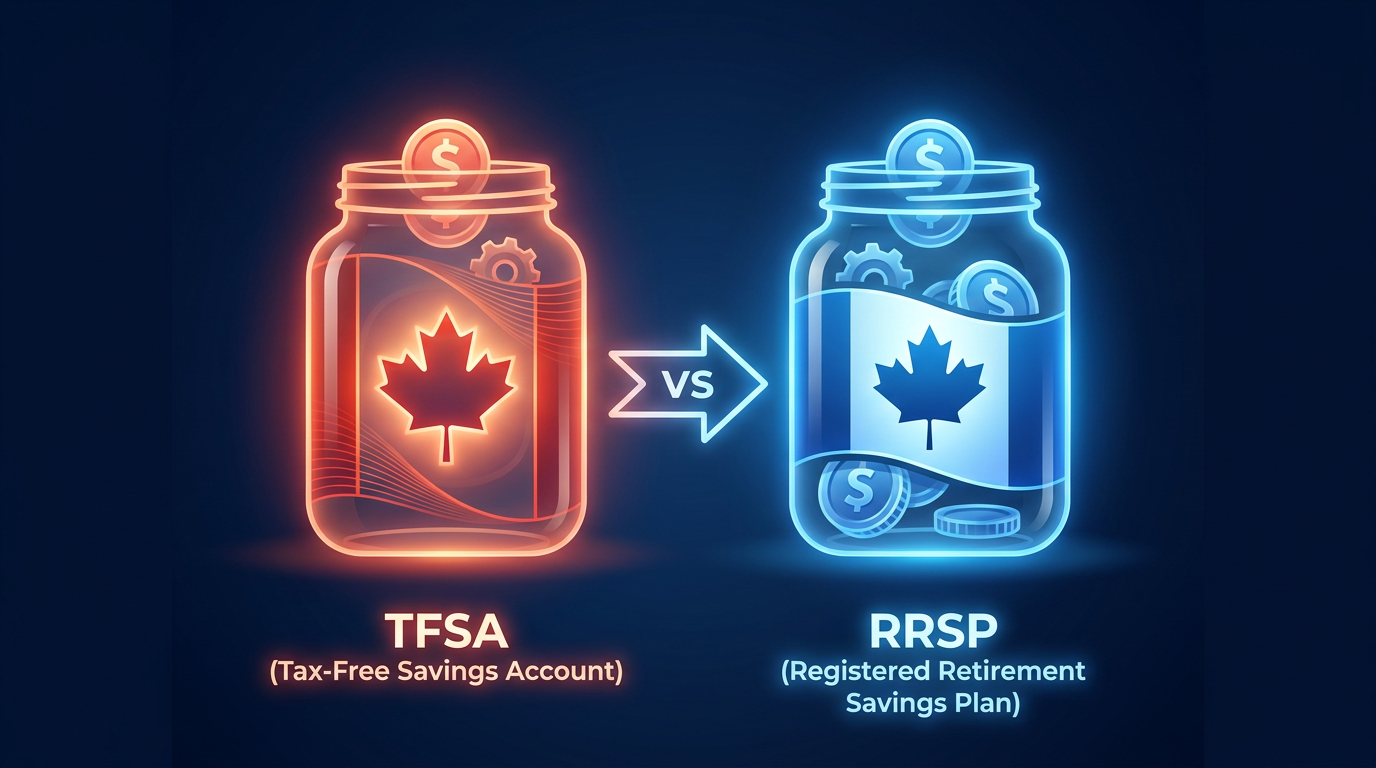
TFSA vs RRSP: Which Canadian Account Should You Prioritize?
It's the most common question in Canadian personal finance: "Should I contribute to my TFSA or RRSP first?" The answer depends on your income, tax bracket, and financial goals — but the math gives us clear guidelines.
TFSA vs RRSP: The Quick Comparison
| Feature | TFSA | RRSP |
|---|---|---|
| Tax on contributions | After-tax dollars (no deduction) | Tax-deductible |
| Tax on growth | Tax-free forever | Tax-free while inside |
| Tax on withdrawal | Tax-free | Taxed as income |
| Contribution room (2026) | $7,000/year | 18% of income (max ~$32,490) |
| Unused room | Carries forward | Carries forward |
| Withdrawal flexibility | Anytime, room restored next year | Anytime but room is lost |
| Best for | Lower income, emergency funds, flexibility | Higher income, retirement savings |
The Golden Rule
Here's the principle that simplifies everything:
- If your tax rate today is LOWER than it will be in retirement → Prioritize TFSA
- If your tax rate today is HIGHER than it will be in retirement → Prioritize RRSP
In practice, this often means:
- Income under ~$55,000: TFSA first (you're in a lower bracket now)
- Income $55,000–$100,000: Mix of both, leaning RRSP
- Income over $100,000: Max RRSP first (big tax savings now)
Run your exact scenario with our TFSA & RRSP Calculator to see projected growth for both accounts.
TFSA: The Underrated Powerhouse
Most Canadians underutilize their TFSA. Here's why it's so powerful:
- True tax-free growth: A TFSA that grows from $50,000 to $500,000? You keep every penny tax-free
- No impact on government benefits: TFSA withdrawals don't affect OAS, GIS, or other income-tested benefits in retirement
- Flexibility: Withdraw anytime without penalty. Contribution room is restored the following January
- Estate planning: Name a successor holder (spouse) and the TFSA transfers tax-free
Since the TFSA began in 2009, a Canadian who was 18+ and contributed every year has accumulated $95,000 in lifetime contribution room (as of 2026).
RRSP: The Tax Deferral Machine
The RRSP's power comes from the immediate tax deduction:
- Earning $90,000 in Ontario? A $10,000 RRSP contribution saves you ~$3,150 in taxes
- Invest that $3,150 tax refund back into your TFSA and you're maximizing both accounts
- Use the Home Buyers' Plan (HBP) to withdraw up to $35,000 tax-free for a first home
- The Lifelong Learning Plan (LLP) lets you withdraw up to $20,000 for education
The Ultimate Strategy: Use Both
The smartest Canadian investors don't choose one — they use both strategically:
- Contribute to RRSP to reduce taxable income
- Invest the tax refund into TFSA
- Use TFSA for emergency fund and medium-term goals
- Use RRSP primarily for retirement
Common Mistakes to Avoid
- Treating TFSA as a savings account: Invest it in ETFs/index funds, not just savings accounts earning 2%
- Over-contributing: CRA charges 1%/month penalty on excess contributions
- Withdrawing and re-contributing TFSA in the same year: You lose the room until January 1
- Ignoring RRSP in high-income years: The tax savings are too significant to pass up
Ready to Optimize Your Accounts?
Use our TFSA & RRSP Calculator to compare growth projections, calculate your tax savings, and find the right balance for your situation. Then check your overall financial picture with the Net Worth Calculator and set savings goals with our Savings Goal Calculator.
Disclaimer: This article is for educational purposes only and does not constitute tax or financial advice. Contribution limits and tax rules are subject to change. Consult a qualified financial advisor for personalized guidance.
❤️ Found this helpful?
Share it with someone who needs to see this.
Get Smarter About Money
Weekly tips on investing, saving, and building wealth. Join thousands of smart investors. No spam, ever.