
Roth IRA Conversion: Is It Worth Paying Taxes Now to Save Later?
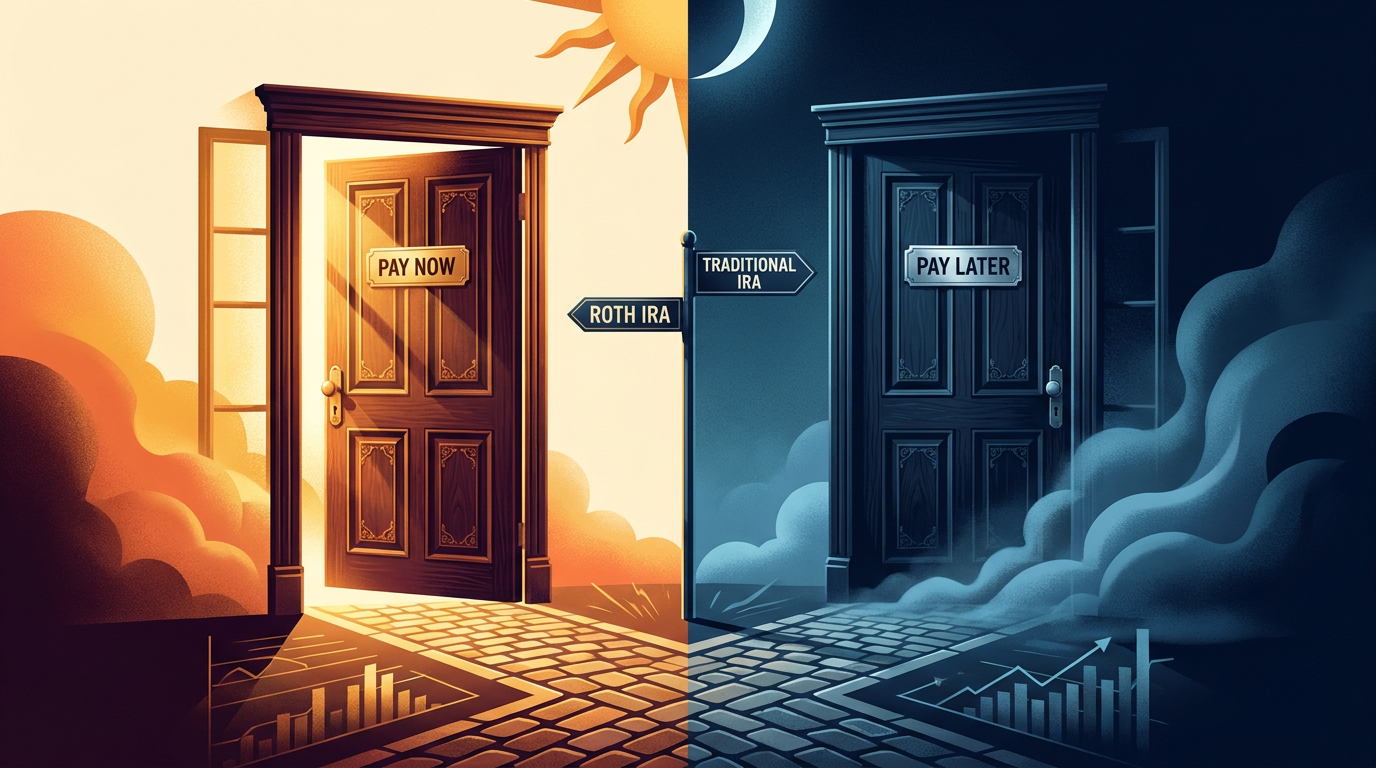
A Roth IRA conversion is one of the most powerful — and most misunderstood — moves in retirement planning. By converting Traditional IRA or 401(k) funds to a Roth IRA, you pay taxes today but never again on that money. For the right person at the right time, it can save tens of thousands in lifetime taxes.
How a Roth Conversion Works
When you convert from a Traditional IRA to a Roth IRA:
- You move money from your Traditional IRA (pre-tax) to a Roth IRA (post-tax)
- The converted amount is added to your taxable income for the year
- You pay income tax on the converted amount at your current tax rate
- Once in the Roth, the money grows tax-free forever
- Withdrawals in retirement are completely tax-free
Run your conversion scenarios with our Roth IRA Conversion Calculator.
When a Roth Conversion Makes Sense
A conversion is often smart when:
- You're in a low-income year: Between jobs, sabbatical, early retirement before Social Security kicks in
- You're early in your career: Lower income now means a lower tax rate on the conversion
- You expect higher future tax rates: Either from income growth or potential tax law changes
- You have a long time horizon: The longer the money grows tax-free, the bigger the advantage
- You want to reduce Required Minimum Distributions (RMDs): Roth IRAs have NO RMDs during your lifetime
- Estate planning: Pass tax-free money to heirs instead of tax-burdened Traditional IRA funds
The Math: A Real Example
Scenario: You're 45 with $200,000 in a Traditional IRA, in the 22% tax bracket now, expecting 24% in retirement.
| Keep Traditional IRA | Convert to Roth IRA | |
|---|---|---|
| Current balance | $200,000 | $200,000 |
| Tax paid now (22%) | $0 | $44,000 |
| Value at 65 (7% growth) | $773,937 | $773,937 |
| Tax on withdrawal (24%) | $185,745 | $0 |
| Net after-tax value | $588,192 | $773,937 |
| Advantage | +$185,745 |
That's an extra $185,745 by paying taxes now at a lower rate. And if you can pay the conversion tax from a separate savings account (not the IRA itself), the advantage is even larger.
The Partial Conversion Strategy
You don't have to convert everything at once. The smartest approach is often to convert just enough each year to "fill up" your current tax bracket without pushing into the next one.
For example, if you're in the 22% bracket (up to $100,525 for single filers in 2026) and your taxable income is $70,000, you could convert $30,525 at the 22% rate without triggering the 24% bracket.
Common Mistakes to Avoid
- Using IRA funds to pay the tax: This reduces your Roth balance and may trigger a 10% early withdrawal penalty if under 59½
- Converting too much in one year: A massive conversion can push you into a much higher bracket and even affect Medicare premiums (IRMAA)
- Forgetting the 5-year rule: Converted amounts must stay in the Roth for 5 years to avoid penalties on earnings
- Not considering state taxes: Some states tax Roth conversions; others (like Florida, Texas) have no state income tax
Backdoor Roth IRA
If your income is too high for direct Roth IRA contributions ($161,000+ single, $240,000+ married in 2026), the backdoor Roth strategy lets you contribute to a Traditional IRA (non-deductible) and immediately convert to a Roth. This is legal and widely used, but watch out for the pro-rata rule if you have existing pre-tax IRA balances.
How to Decide
Use our Roth IRA Conversion Calculator to model your specific situation. Compare keeping your Traditional IRA vs. converting at different amounts. Factor in your current bracket, expected retirement bracket, and time horizon.
Also consider your complete retirement picture: use our Retirement Calculator to see if you're on track, and our Capital Gains Tax Calculator to understand your full tax picture.
Disclaimer: This article is for educational purposes only. Tax laws are complex and subject to change. Consult a qualified tax professional before making Roth conversion decisions.
❤️ Found this helpful?
Share it with someone who needs to see this.
Get Smarter About Money
Weekly tips on investing, saving, and building wealth. Join thousands of smart investors. No spam, ever.